Monday, 25 February 2013

The Alternative Clothes Show 2013


Strike a pose on the catwalk at the Alternative Clothes Show 2013.  This is a chance to showcase clothing that is precious.  Maybe it's handmade, or upcycled,  or it could be treasure from your granny or the local charity shop! 
The Alternative Clothes Show is on Sunday 17 March, 2-5pm at Hornsey Vale Community Centre, 60 Mayfield Road, N8 9LP.    
We are also looking for people to come and display or sell handmade items, upcycled clothes or locally sourced textiles.  Prices for tables are as follows:

  • Display: Free
  • Traders: £12
  • Private Sellers: £8

For further information: info@hornseyvale.org or ring Tanya 0208 348 4612
This is joint event organised by Transition Crouch End and Hornsey Vale Community Cente  We will be promoting clothes that are ethically sourced, local, or recycled.  We want to raise awareness about the ethical, environmental impact of the mainstream clothing industry.  And we want to have fun!
For more information: www.transitioncrouchend.org or www.hornseyvale.org


Monday, 21 January 2013

Seville Marmalade for 55p a jar

Unfortunately I can't do that.  

I tried. I bought 2 kilos of granulated sugar at 99p each and a kilo of Seville oranges for £1.99, from my local greengrocers, the Broadway Fruiterer in Crouch End (lovely old-fashioned name).  Plus two lemons for 60p.

I used River Cottage Pam the Jam's method and boiled the whole fruit for two and a half hours in two and a half litres of water at a steady simmer. I halved the now softened fruit, poked out the pips, and sliced the peel into fine strips.  Removing the pips was a bit of a chore, but handling the tender, squishy pith was quite pleasurable. 

Then I topped up the water to 1.7 litres, tipped in the pulp and peel and poured in two kilos of warmed granulated sugar. Plus the juice of two lemons to ensure the right level of pectin.  (I added in a little extra, because when I did the methylated spirit test for pectin, the liquid didn't clump.)

I placed the temperature probe in the preserving pan and waited for the alert,  knowing that when my concoction had reached 105 degrees C,  the setting point of 104.5 had been reached.  This made for a rather relaxed marmalade making session: the probe meant I could actually leave the pan for half an hour, confident that the resulting marmalade would set.

It did and this is how it looked.


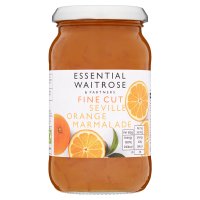
But then there was the stress of working out how much it cost. In the end, I made 3040g of marmalade and spent £4.57. Or to put it another way, each 100g of my marmalade cost 15p.  But that's still more than Waitrose's Essential Fine Cut Seville Marmalade which at 55p a jar, costs 12.1p for every 100g.

How can they do that?!!  My costs didn't factor in the three hours' use of gas or the considerable labour, and that was using the whole fruit method.  (Cutting up the peel before being softened is even more effortful and time-consuming.) The jars were free, since they were recycled. I hadn't included the industrial chemicals in the Waitrose version: citric acid, gelling agent pectin, acidity regulator sodium citrates, firming agent calcium chloride.

However looking at their ingredients, their marmalade contained 26% fruit, whereas mine contained 33%, and while their sugar content at 63% was roughly equivalent to mine, this included glucose-fructose syrup, or corn syrup as it is known in the USA. Corn syrup is cheaper than sugar and is a much used ingredient in processed food; it is not so easily digested by the body and research has suggested that excessive consumption can lead to obesity.  

I'm not saying that consuming large amounts of Essentials Waitrose Marmalade will make you fat; that is the nature of sugar!  But I feel more reassured, pleased even, that I failed the budget marmalade challenge.  All my ingredients were natural and my citric acid and pectin came from the fruit itself.  Moreover I did not have to resort to cheap, potentially harmful substitutes and I know my marmalade will not go off, because of the way it has been prepared.  That's why it is called a 'preserve.'

Or to put it another way, for well under a fiver, I made over eight jars of delicious marmalade, with complex flavours and a lovely consistency.

And with a bit of tweaking and little extra cost, I can add a splash of whisky or a few grams of stem ginger to make my own Wastelady speciality.

Now that's a premium product.


Saturday, 12 January 2013

Wassailing Time Again


Last year we wassailed the trees in Harold Road Garden and this is what we sang.


Our little song honoured the lovely apple trees in Harold Road Garden, including the splendid specimen donated by Blackmoor Estate on Apple Day: we'll be expecting hatfuls and bagfuls and barn floors of apples in summer.  A little bit of Wassail Punch and soggy toast at the foot of each tree followed by a communal sup from the Wassailing Bowl all helped combat the winter chill.  The brew was a mysterious punch made of baked apples, ale, sugar, Christmas spices and just a dash of Pimms. Afterwards we sang our song, and no-one seemed to mind, certainly not the Police Station next door.

Thanks to everyone who came and to Bethany who taught us a Cornish Wassailing Carol, lyrics courtesy of her smart phonb, and her friend, David who accompanied our dowsing with his melodeon.

Here's Bethany's version -just a taster - there are ten verses... 

 1. Wassail! wassail! all over the town,
Our toast it is white and our ale it is brown;
Our bowl it is made of the white maple tree;
With the wassailing bowl1, we'll drink to thee.


 2. Here's to our horse, and to his right ear,
God send our master a happy new year:
A happy new year as e'er he did see,
With my wassailing bowl I drink to thee.


3. So here is to Cherry and to his right cheek
Pray God send our master a good piece of beef
And a good piece of beef that may we all see
With the wassailing bowl, we'll drink to thee


4. Here's to our mare, and to her right eye,
God send our mistress a good Christmas pie;
A good Christmas pie as e'er I did see,
With my wassailing bowl I drink to thee.


Wednesday, 2 January 2013

Glamping in Almayate, Spain

A pair of earplugs is not usually part of a welcome pack but it certainly proved useful that first night at our ‘glampsite’ in Almayate, on the Costa del Sol.  Our hosts, Richard and Carol apologised in advance for the feria that rollicked until 4am in the morning.  Perhaps it did, I don’t know.  I was sound asleep. 

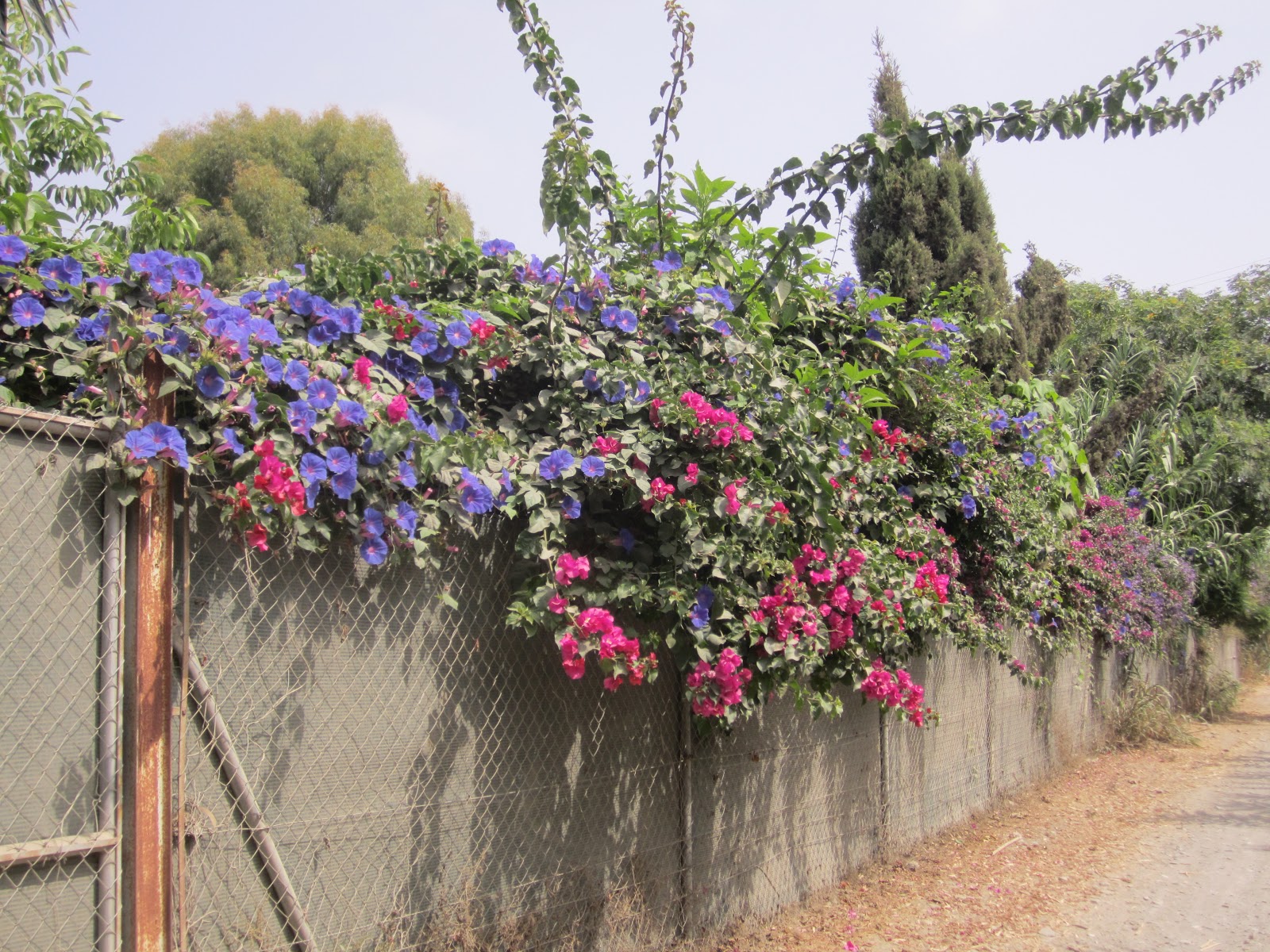
A Mongolian yurt in Andalucia suggests remoteness and retreat.  This wasn’t really the case here. Arriving at 10pm, we were assailed by the heady smell of bougainvillea and oleander and the tick, tick, ticking of the automatic watering system. 
The yurt was positioned by a gate with parking space for two cars and a path to a wooden structure, comprising a kitchen and bathroom and dining areas outside. At the other end of the garden were two pools, one a water feature housing carp, the other an oversized paddling pool, which our hosts would tend lovingly during our week long stay. Nocturnal excursions to the loo were easily achieved as the path flooded with light on passing.  Inside the yurt was dominated by a fine double bed, underneath a circular gap in the roof, which revealed the stars at night, although for more sublunary souls there was Sky TV and Wi-Fi.

In the distance, you could hear the rumble of traffic streaming along the coast.  I relinquished the idea of silence, punctuated only by the cry of vultures and the clanging of goat bells.  Instead early the next morning we were woken up by a rhythmic ringing sound, as Pepe, the local farmer trundled his oxen cart to the local market.  Another reason for having ear plugs.


I was intrigued by the juxtaposition of tourism and agriculture: apartment blocks beside a field of goats; a vegetable patch that merged into a site for billboards.  It was easy to avoid roads and in time the traffic sounds faded into my unconscious.  As the July temperatures crept up into the high thirties, we wanted to bathe.  The back way took us past acequias which irrigated fields of cucumber, courgette and pepper, and a simple smallholding with two chairs, a radio and a skittish kitten. We found the beach eventually with its basic beach bar and two types of gin.

Carol and Richard told us how they had escaped the rat race to live a simple life.  Here it was all around us in abundance.

You can find out more about Glamping in Almayate on Carol and Richard's website: http://www.glampingspain.co.uk

Monday, 10 December 2012

Wreath making in Hornsey Vale Community Centre

From this...

To this...
And this..

And this...
And this...


And this...


 And this...
And this...


And this...


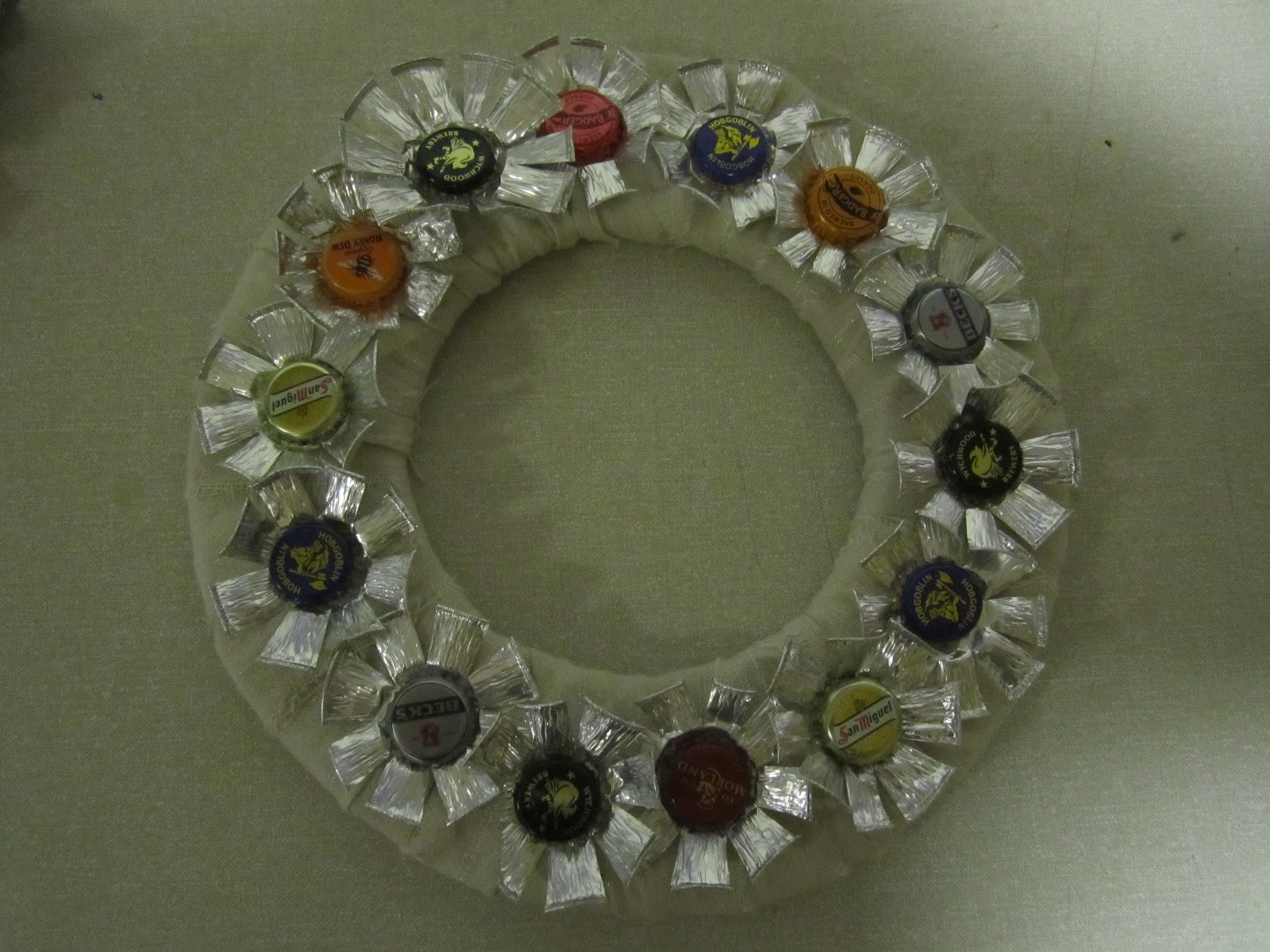
Approximate materials used: twelve daily lens foils (at least), eleven bottle caps, ten cardboard rings, nine bits of jigsaw, eight Christmas cards, seven metal studs, six mince pie cases, five felt strips, four wraps of twine, three baubles, two serviettes and a sparkly, charity shop scarf. 

And of course, the people who made them: Lynne, Michele, Alex, Pamela and Gillian.

The wreaths will be on display in Hornsey Library Cafe until Sunday 16 December.  They look even nicer in real life!

Next event:  Make a wreath for your front door in Stationers Park on Friday 14 and Saturday 15 December 1.30-3.30 pm.   

Sunday, 2 December 2012

Wreath Week Sunday 9- Saturday 15 December

Looking through the Metro and the Evening Standard, I was struck by the array of wreaths available at the moment.  Christmas wreaths are obviously in this year.  They do cost however, from £7.50 for a twig wreath from Tescos to a lovely felted ball creation from www.notonthehighstreet.com

But you can make your own!  There will be two opportunities to make an indoor and outdoor wreath during the week of Sunday 9-Saturday 15 December, which is now designated 'Wreath Week'.

Sunday 9 December 7.30 pm -9.30 pm at Hornsey Vale Community Centre, in the Small Hall where we'll have two hours to make an indoor wreath from recycled paper and card.  We will provide the cardboard, if you bring cards and magazines to cut up. The end result will be lovely.

If you want to bring  your own WIP (work in progress to the uninitiated), please do.  There are lots of ideas on the internet - - just google 'recycled wreath'.

Something to drink as an aid to creativity is always welcome.  There will be snacks to nibble - just email me know if you're coming so I know numbers: wasteladyN8@gmail.com

Friday 14 and Saturday 15 December 1.30 pm-3.30pm.  These two days are run by the Stationers Park Volunteer Group, which has been active every second Friday in the Park.  On Friday a winter pruning will produce lots of lovely twigs, which we will be turning into outdoor wreaths and then decorating with berries and foliage.  We will be there on Saturday as well.  

Wouldn't it be lovely if all the houses on Denton Road and Mayfield Road had wreaths made from cuttings from Stationers Park?  And all for nothing but a bit of time and creativity.

And finally, Robin from the IF cafe in Hornsey Library would love to exhibit our recycled wreaths, the week beginning Monday December.

Tuesday, 27 November 2012

Sometimes the eye is bigger than the belly


For the last ten days, I've been taking part in the Recycle for London Food Waste Challenge. Last weekend I managed to chalk up over 3 kilos of food waste.  I appreciate that the challenge is not about creating as much waste as possible, but I was very happy with the total.  Here’s why. 

The problem with a challenge like this is it tends to be self-selecting: the people who sign up are probably already very aware of eating sustainably and rather pleased with the way they manage food and leftovers economically and creatively.  My blog persona (WasteladyN8) is such a one. So if anything my aspiration for this fortnight has been to produce a zero result, not just reduce my waste..

But then I went to stay with my elderly mother in Ireland.  My mum is 92 and lives on her own.  She is part of a kindly village community and is well supported by friends and local services.  Every Friday she rings through her food order to the local Spar who deliver four or five bags of groceries (plastic bags, I’m afraid, but we will see what happens when the ban comes through in Northern Ireland).  My brother and I come to see her regularly and then there are usually twice as many bags!

During my visit, one of my jobs is to clean out the fridge and the vegetable rack: hence the shameful total in this week of Food Waste Challenge.  So what kind of things featured in the list of shame?  Sausages, pies and dairy products, now out of date; bruised or mouldy fruit and vegetables; stale bread; and a pie case that had lost its crispness.


Actually although I used the word, ‘shame’ (twice), I don’t want to be judgemental.  For one thing, some of the items were mine, mostly the fancy ones, such as the pie case and the apples I was going to make into chutney.  When I asked my mum why she ordered so much, she explained that she followed the list she always used, because it was easier to do this 'automatically.’  Bending down, checking the fridge, planning meals ahead is an effort.  Her diet is very simple and healthy but she never actually eats all the cauliflower, carrots and head of celery she orders every week.  I suspect the vegetables are really an aspiration, one she never quite lives up to, and she is not alone there.  It’s a bit like having a gym membership and never going.

In my mother’s case, buying food is just another chore which she needs to make as easy as possible, relying on a trusted formula which is not responsive to different situations.  I have tried putting systems in places, such as lists and inventories, but in the end, it is up to her.  Asking her helper to put away the groceries and write a list for the coming week might be the solution, but Mum needs to be involved in the process. 

Another factor is the guests.  When my brother, wife, son and new wife came to stay, Mum ordered three of everything, except for the chicken.  She ordered two of those.  Help! They were so full afterwards, they could hardly stand. 

My mother’s attitude to food is not atypical in Northern Ireland.  Surprising for such thrifty, down-to-earth people, the helpings in restaurants and hotels are enormous and the best compliment you can bestow upon a restaurant is, it gives you ‘a good feed.’  The carvery is the meal of choice, always difficult for me, because of the compulsion to balance a bit of everything on one plate, return to the table and then struggle to finish.  A local hotel introduced a similar system for desserts, but that proved uneconomic: a waitress is now employed to stand guard over the array of sweet temptations.

For me the challenge of food waste is not just to reduce or reuse it creatively but to explore the psychology behind it.  The upside of waste is to see it not as extravagance and poor management, but abundance, a perception which is deeply embedded in our culture and indeed psyche.  We know we are hardwired to eat high calorie foods for fear of famine and starvation, and to feast on surplus. 

By the same token, appearing stingy is inhospitable and so we overcompensate by being overly generous with portions and choice.  And just as the provider does not want to appear stinting, the recipient does not want to seem ungrateful or ungracious.  I suppose the solution is to desist, to say a gentle and firm, ‘No thank you,’ which will establish boundaries and set precedents, but that is not always easy in social (and family) situations.
 
Reducing food waste should be fun, a challenge to meet and cherish, not another opportunity to feel less than perfect.  In a world of abundance and opportunity, we all slip up.   As I go into the second week, I am curious to see what my results will be and I'm hoping to finally get round to making that chutney!