
Friday, 15 November 2019

Saturday, 12 October 2019
Makers' Market or Craft Fair/Fayre?
 |
| Knitters at Brixton Makers' Market |
Mention a ‘craft fair’ and what comes to mind?
Stalls, of course. A
delightful place to visit. Tea and cake. Scarves and earrings, all the stuff
you find in a National Trust gift shop.
Essentially a day out, to browse a few stalls, buy something nice for a
friend’s birthday and take a chance on the weather.
The heritage setting is key: look how the
Channel 5 show, The Wonderful World of Crafting chooses a charming place for each
programme: https://www.channel5.com/show/the-wonderful-world-of-crafting/
From a business point of view, craft fairs are a great
way to make money. The fee for the stall can be used to fund other projects and
support worthy causes, and as long as the organisers attract enough punters, the stall holders should be happy. The more stall holders, the greater the profit;
the more stallholders, the greater the attraction, the more people come, the
greater the takings. Everybody happy.
The Makers’ Market I have in mind is somewhat different.
Linguistically, with a bit of alliteration, it puts the makers at the centre of the event This is to encourage conversation
with the seller about their craft, the origins of the materials they use, and
their passion for making. A maker is
always happy when they sell on the day, but they are particularly delighted
when they engage with a customer and take on a commission. Co-production of
this nature is less wasteful of energy, time and materials; no-one wants a pile
of unsold items... And how great to own
a piece of work, made to your requirements from someone you know!
So for our Makers’ Market, yes, there will be tea and cakes
(and mulled wine too). The setting is
Hornsey Vale Community Centre, whose architecture is more 70s than heritage,
but which is convenient for Crouch End and the W3 and W5 bus routes. There will be a range of interesting items
for sale, lovely gifts for Christmas and beyond. The majority of our stallholders will have
made the items they sell. They will have
sourced their materials, decided on a design, and spent hours, working on their
creation.
Come and talk to them!
The Makers Market is not for profit event at Hornsey Vale
Community Centre, on Sunday 8 December, 3-6 pm.
If you would like to sell at this event, please email me at: Wasteladyn8@gmail.com and I will send
you further details.Thursday, 2 May 2019
A Vintage Life - Ways to Avoid Single Use Plastic
One billion elephants!
Or 8.3 billion tonnes. That's how much plastic has been produced when the plastics industry really took off in the fifties. Of that amount, 9% has been recycled, 12% has been incinerated and the remaining 79%? Well, you've seen the pictures on TV...
In the fifties, our grandparents reeling from war-time shortages and post-war rationing, kept everything. (I know that from having taken over a year to clear my mother's house.) They bought their groceries and meat from small independent shopkeepers who wrapped their purchases in paper. They sat down to eat at the family table and had two sets of cutlery: one for everyday, one for best. They had tea parties for special occasions with tea-sets and tea-pots and tea leaves.
They tucked handkerchiefs in sleeves or pockets and gave pretty embroidered sets as presents. At the same time, they embraced this new extraordinary material which could be used to store food safely and they loved the affordable jewellery that sparkled and gleamed and looked like real thing: amber, pearl, ivory and coral.
Thanks to their careful curation of these precious things, many of them are still around. So can revisiting the past, help us reduce our plastic waste and create own plastic free legacy? Here's some ideas.
1) Use tea leaves (and tea-pots!) Almost all teabags contain a plastic sealant, polypropylene, to stop them disintegrating. Contrary to popular belief, they won't biodegrade in your compost.
2) Use handkerchiefs. Tissues are 100% paper but they can't be recycled or flushed away and they come in plastic wrapping (even the boxes).
3) Bring your own cutlery (and napkin) to work.) Each year in the UK we get through 16.5 billion pieces of disposable cutlery and we are among the biggest users of straws on the planet: 42 billion per year.
4) Use soap and shampoo bars and display them on pretty vintage ceramic dishes. These are Poole, made in the sixties, hand painted, each with their individual maker's mark.
5) Use Tupperware. You can take it to your friendly local shopkeeper and producer and avoid plastic bags and food trays. An estimated 2.26 million tonnes of plastic packaging is produced in the UK each year, of which three fifths ends up being dumped)
6) Avoid clingfilm. In the UK we love cling film, 1.2 million metres every year, to be exact; that's an annual 44m per household. Switch to beeswax wraps.
Beeswax wraps are a brilliant way to wrap food stuff (although avoid meat) and can be shaped into pockets and boxes. My beeswax wraps are !00% vintage cotton infused with a blend of beeswax, anti-bacterial jojoba oil and pine resin (to make the wraps cling). In future I plan to use beeswax from local beekeepers.
The wraps can be wiped or rinsed in lukewarm water; they should last at least a year and can be refreshed by putting them into a warm oven for a few minutes. Once they finally reach their end of life, simply put them in the compost.
Or 8.3 billion tonnes. That's how much plastic has been produced when the plastics industry really took off in the fifties. Of that amount, 9% has been recycled, 12% has been incinerated and the remaining 79%? Well, you've seen the pictures on TV...
In the fifties, our grandparents reeling from war-time shortages and post-war rationing, kept everything. (I know that from having taken over a year to clear my mother's house.) They bought their groceries and meat from small independent shopkeepers who wrapped their purchases in paper. They sat down to eat at the family table and had two sets of cutlery: one for everyday, one for best. They had tea parties for special occasions with tea-sets and tea-pots and tea leaves.
They tucked handkerchiefs in sleeves or pockets and gave pretty embroidered sets as presents. At the same time, they embraced this new extraordinary material which could be used to store food safely and they loved the affordable jewellery that sparkled and gleamed and looked like real thing: amber, pearl, ivory and coral.
 |
| A random selection of beads from my mother's jewellery box |
1) Use tea leaves (and tea-pots!) Almost all teabags contain a plastic sealant, polypropylene, to stop them disintegrating. Contrary to popular belief, they won't biodegrade in your compost.
 |
| J G Meakin Studio teapot and vintage tea caddies |
2) Use handkerchiefs. Tissues are 100% paper but they can't be recycled or flushed away and they come in plastic wrapping (even the boxes).
3) Bring your own cutlery (and napkin) to work.) Each year in the UK we get through 16.5 billion pieces of disposable cutlery and we are among the biggest users of straws on the planet: 42 billion per year.
4) Use soap and shampoo bars and display them on pretty vintage ceramic dishes. These are Poole, made in the sixties, hand painted, each with their individual maker's mark.
 |
| Hand painted Pool pottery from the s 60with vintage soaps |
 |
| 70s Tupperware in various sizes |
6) Avoid clingfilm. In the UK we love cling film, 1.2 million metres every year, to be exact; that's an annual 44m per household. Switch to beeswax wraps.
 |
| 50s fabric turned into beeswax wraps |
Beeswax wraps are a brilliant way to wrap food stuff (although avoid meat) and can be shaped into pockets and boxes. My beeswax wraps are !00% vintage cotton infused with a blend of beeswax, anti-bacterial jojoba oil and pine resin (to make the wraps cling). In future I plan to use beeswax from local beekeepers.
The wraps can be wiped or rinsed in lukewarm water; they should last at least a year and can be refreshed by putting them into a warm oven for a few minutes. Once they finally reach their end of life, simply put them in the compost.
Saturday, 16 December 2017
WasteladyN8 Studios
At WasteladyN8 Studios, the material comes first.
Every sample, off cut, discard, charity shop reject, discontinued line, junkshop find, however bent and battered, biffed and buffeted, frayed and friable, is interesting to us. We squirrel, and hoard horribly.
Every find is a project. Before we stash, we explore possibilities: it is not what to do with the material, but what not to do with it. The best way to use a resource is to experiment with it, but what if, there is no more of it to be had?
No matter - limitation inspires creativity. Everything we produce has been crafted, not just in its execution, but also in the thinking behind it. The outcome is an item, that is unique, a one-off, never to be repeated, because the material we have used no longer exists.
The wasteladyn8 blog is not just a showcase of items we have made. It
is also a discussion of the journey towards the finished product, the twists
and turns and glorious dead ends we encounter. It is about finding
material and rediscovering it.
Every sample, off cut, discard, charity shop reject, discontinued line, junkshop find, however bent and battered, biffed and buffeted, frayed and friable, is interesting to us. We squirrel, and hoard horribly.
Every find is a project. Before we stash, we explore possibilities: it is not what to do with the material, but what not to do with it. The best way to use a resource is to experiment with it, but what if, there is no more of it to be had?
No matter - limitation inspires creativity. Everything we produce has been crafted, not just in its execution, but also in the thinking behind it. The outcome is an item, that is unique, a one-off, never to be repeated, because the material we have used no longer exists.
 |
| Small purses made from Donegal tweed offcuts - material no longer available! |
 |
| Brooches made from Paul Smith silk samples, sold at a pop-up shop. |
Monday, 23 October 2017
Robin Livingstone 1920-2017

From My Kitchen Window
The theme for my story is taken from the film, Casablanca, the lovely, sad song: 'As Time Goes By...'
As I sit at my kitchen window the scene changes by the hour. The post-man in his 'little red van' is the first to arrive. Disappointing, no letters! Only circulars about great deals from supermarkets and letters from charities asking for donations for worthy causes. Today, nobody has time to write; it's all texts and emails.
The afternoon is quite exciting. I see businessmen home for lunch. Wives drive to supermarkets. Nobody walks to the local shop with a shopping bag today. It's all trolley, plastic bags into the boot of the car and home.
Vapour trails in the sky mean the plane is on time as it flies towards City of Derry Airport. The bus passes bringing children home from school. The lady walks her dog and the neighbour's big ginger cat takes its afternoon stroll around the garden.
In the evening I watch for the crows on their way to roost in the tall trees, and keep warm near the road's lights during the night.
Sometimes, there is a spectacular sunset. I stand in awe as the sky glows with colours - red, gold, yellow and primrose - a scene not even David Hockney could paint.
The road light outside my window has come on. It's time to draw the curtains and call it a day.
Days of the week are known by what is happening outside my window. There's the bin lorry, so it must be Thursday. Sunday means neighbours drive off to church - men in tailored suits, ladies with freshly styled hairdos. Sunday is no day for jeans and anoraks.
As the seasons roll by I enjoy my garden. Spring brings flowers - snowdrops to cheer cold January days and daffodils at Easter. May brings life to a my cherry tree. I watch it from bud to leaf to blossom and sadly, it forms a carpet of pink petals on the grass.
I look out of my window and listen as a pair of doves coo a duet on the telephone wires while a blackbird searches for worms to feed its chicks.
I welcome the swallows, and the butterflies feeding on nectar from the buddleia bush. Summer is here at last.
Autumn, although a season of fruit and Harvest thanksgiving services, fills me with a kind of melancholy. I watch the leaves on my cherry tree colour yellow, then gold and drop off.
There's not much to see during the winter. The only interesting thing was the arrival of a large flock of redwings. They stayed for three days feeding on the little apples on my crabtree. Redwings are beautiful birds with black cap and red wings -they are a delight to watch.
Today I am glad to be sitting in my warm kitchen looking out. Overnight, a snowfall has turned my garden into a sparkling Christmas card. I'll stay indoors. Too old to throw snowballs or make a snowman.
Over the years I have seen babies in prams become toddlers, teenagers, adults and parents themselves: life, full circle.
To conclude, I must confess I have idled away too many hours sitting at my kitchen window. I have never finished my 'Things to Do' list. I just say like Scarlett O'Hara in the film, Gone with the Wind, - 'Tomorrow is another day!'
Monday, 19 May 2014
Giro d'Irlanda?
 |
| The Break Away Group appears |
Traffic commercials in Northern Ireland are usually grim. Coffin
shaped glasses of lager, a mashed up profile, howling parents punch home the
message: driving is dangerous. You are
only a second away, a momentary lapse of concentration away from a horrendous pile-up
of smoking metal and mutilated limbs.
But a more recent DOE information advert, broadcast before
and after the Giro d’Italia, is different. The refrain is ‘Don’t Forget’ as
cyclists and motorists bat back and forth advice on how to share the Road. ‘Don’t forget I need a least the space of a car when you pass me.’ ‘Don’t forget it’s dangerous to pass me on the inside.’ The
final image is of a motorist and cyclist at a junction saying in unison, ‘Don’t
forget, I’m human too,’ followed by the banner, ‘Share the Road. Respect
Everyone’s Journey.’
‘Not forgetting’ is something of an issue in Northern
Ireland. ‘Remember, Remember the 5th
November’ children may intone in England but here we have a litany of dates to
recall and commemorate, triggered by location-specific insignia. A tour around the Sperrins Mountains or the
Glens of Antrim will take in a succession of villages, which offer different
coloured flags: Green, White and Orange ceding to Red, White and Blue. When I was growing up in the seventies, even
the graffiti oscillated from FTP to FTQ where the P stood for the Pope and the
Q for the Queen. The rest you can guess.
So it was a stroke of genius for someone to suggest that
instead of murals, grim-faced election posters and tendentious flags, Northern
Ireland would welcome the Giro d’Italia with ...pink. Not a sugary, girly, Princess pink, but a
school dinner blancmange, cherry blossom, boozer’s nose pink. Ostensibly
marketed to celebrate the Maglia Rosa (or Pink Jersey) worn by the leader of the
Giro d’Italia, Northern Ireland embraced
Pinkness with pride. Yes, the Northern
Ireland community found it could do ‘camp,’ and very well, as it happens. Resulting in pink sheep, pink phone boxes,
pink horses, pink tractors, pink gnomes, pink fish and chips. Even the Grand
Master of the Orange Order welcomed the Giro d’Italia, although as far as I
know, he declined to wear a pink sash.
And everywhere streets and roads were lined with pink bikes and a
festive flutter of floral flags.
During the different stages, the spectators wore pink, even if it was only a magenta rain poncho thoughtfully (and presciently) provided by the Northern Ireland Tourist Board. The Board had bid £4.2 million to entice the Giro d’Italia to come to Ireland and had beaten their nearest rival Venice, a curious place for a cycle race. The Board’s slogan ‘Discover NI’ aimed to market the cities and coast to a global audience, who enchanted by the scenery would come in droves. That didn’t quite work out, alas. What the world wide audience actually saw on their screens was cyclists crashing on dangerously wet streets and not the iconic features of the coast, which swathes of rain made impossible to film.
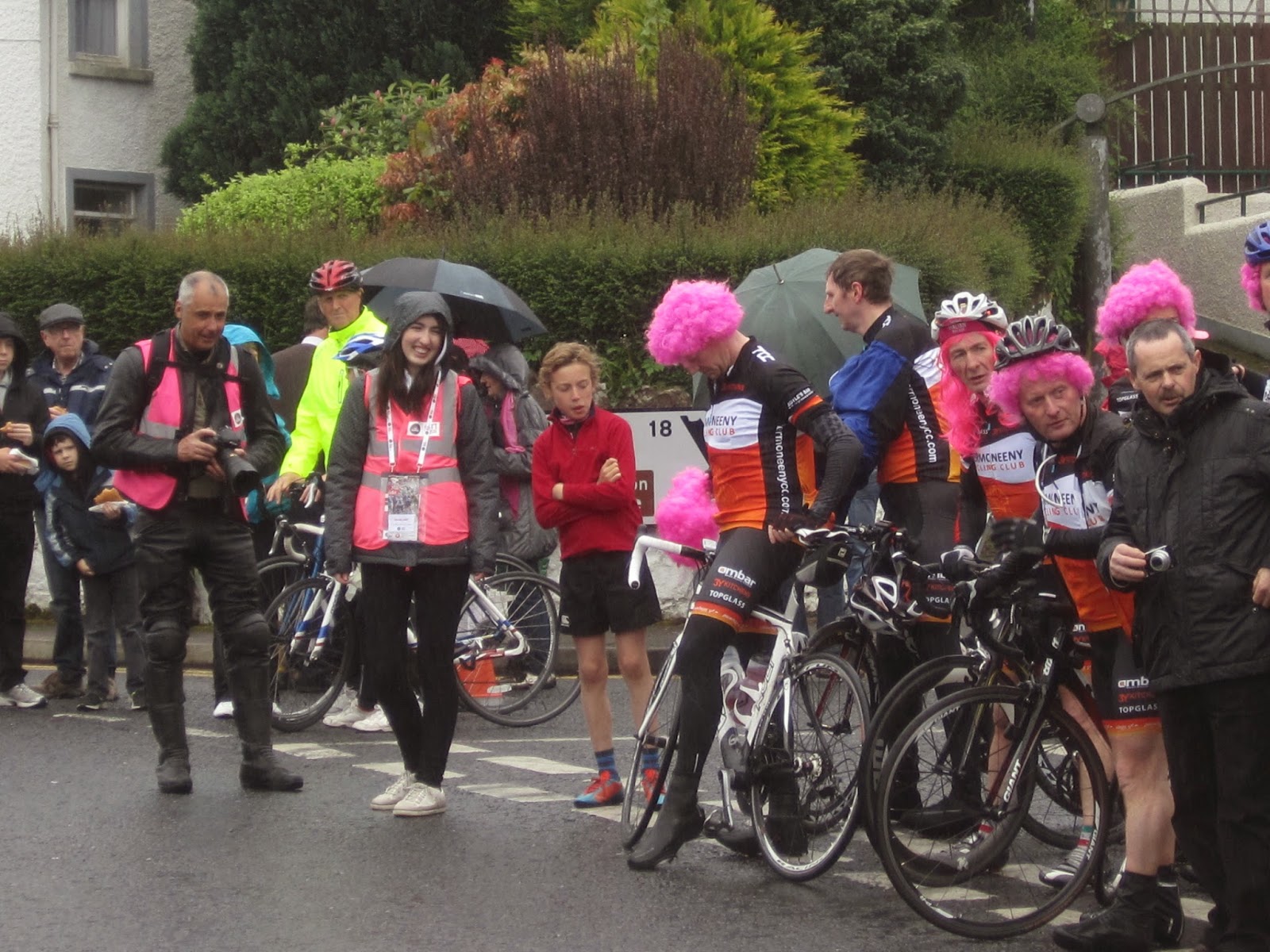 The audience did discover something, however. They knew that many in Northern Ireland like a procession. They
probably knew that Ulster men and women are resilient, somewhat confirmed by
the sight of hundreds of thousands standing in the rain, for four hours
to see four and a half minutes of action.
The audience did discover something, however. They knew that many in Northern Ireland like a procession. They
probably knew that Ulster men and women are resilient, somewhat confirmed by
the sight of hundreds of thousands standing in the rain, for four hours
to see four and a half minutes of action.
But did they know we could be fun? Like the riders on pink horses chasing the
race until they ran out of beach. Or the
water skier keeping pace until he tried to wave at the cyclists and fell into the water.
And I discovered something too. I am a frequent visitor to
my homeland and I would often remark to my husband on the potential there for
excellent cycling. How wrong I was.
There is no potential. People are doing it
now. On the day of the race, we were impressed by the proliferation
of cycle clubs,. We encountered numerous bike riders on the narrow roads, moving as one like flocks of birds, heading to their favoured viewpoint. We chose to coincide with the race at Cushendall, a small
coastal village.
 So what was the race actually like? In the end it was brilliant! We positioned ourselves on the bridge over the River Dall, able
to see the bikes as they came round the sharp corner by the Curfew Tower.
So what was the race actually like? In the end it was brilliant! We positioned ourselves on the bridge over the River Dall, able
to see the bikes as they came round the sharp corner by the Curfew Tower.
So what was the race actually like? In the end it was brilliant! We positioned ourselves on the bridge over the River Dall, able
to see the bikes as they came round the sharp corner by the Curfew Tower.
We waited a long time, standing around in the rain,
observing the crowds, checking our cameras, checking our watches. Until suddenly, we could hear the honking of a
police bike. It ushered in a host of
pink taxis joining in the cacophony and waving huge pink foam hands out the
windows. They were followed by a lull. Quite
a long lull.
And then the bike
outriders were back, beeping madly to tell us the race was coming. It is easy to miss the leaders of the race,
the breakaway group, and take them for a bunch of stragglers. But you know that very soon afterwards (in
this case, four minutes) the peloton will appear.
Watching the pack of
cyclists on the television, you notice how they pedal together, so fluid they seem
to be coasting. They juggle jackets, no hands on the handlebars, poised like
accomplished circus performers.
In the flesh, they were hard. Fast. Pumping like a piston engine. And then they were gone....
In the flesh, they were hard. Fast. Pumping like a piston engine. And then they were gone....
On our journey home, we retraced the giro route, now bathed in sunshine and photographed moments of pink. I hope too visitors will look at the Giro and see Northern Ireland in a different light, not just as a confection of sweet spots to touch and go. I hope they would like to come and experience the community of cycling, just as we did. And I hope they look forward to tapping into the culture of fun, which is so much part of the national character, and which we paraded in pink in the pouring rain.

Monday, 25 February 2013
.jpg)
Subscribe to:
Posts (Atom)